


Why does water-activated kraft paper tape warp when sealing boxes?
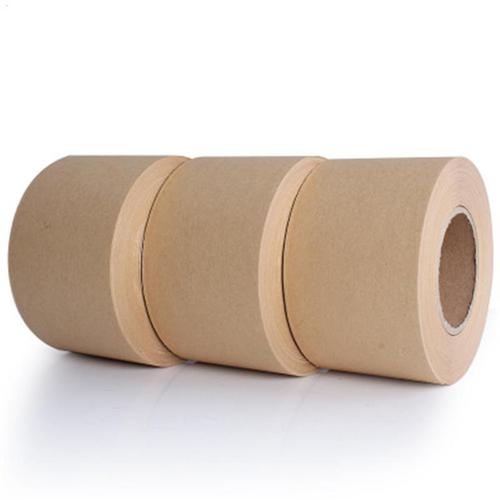
Root Causes & Systematic Solutions
Driven by the global wave of green packaging and sustainable development, water-activated kraft tape (also known as gummed paper tape, reinforced water-activated tape) has become a highly favored carton sealing material in e-commerce logistics, heavy-duty cartons, export packaging, and cold chain transportation across Europe, the United States, Japan, South Korea and other countries. Its advantages include full biodegradability, ultra-high tensile strength, eco-friendliness, non-toxicity, writable surface, and excellent tamper evidence.
However, this "activates with water" tape often encounters edge lifting in real-world applications: hours or days after sealing, the edges gradually detach from the carton surface. In mild cases it affects appearance, while severe cases cause box splitting, product leakage, and even customer claims.
Unlike self-adhesive hot-melt tape, the lifting mechanism of water-activated kraft tape is far more complex—it involves multiple physicochemical changes: water activation, adhesive curing and crystallization, wet expansion and dry shrinkage of paper fibers, and interactive environmental factors (temperature/humidity).
Edge lifting is by no means simply "insufficient tackiness" — it must be analyzed from five perspectives: water, adhesive, paper, environment, and user operation. As a professional manufacturer specializing in R&D and production of kraft tape, Suzhou Zhongming New Material Technology Co., Ltd. will deeply dissect the root causes of edge lifting from five dimensions: adhesive system, substrate characteristics, production process, environmental factors, and operational specifications. We provide a full-chain solution covering tape selection, storage, activation, application, and post-treatment, helping packaging practitioners permanently eliminate the edge lifting headache.
1. What is Water-Activated Kraft Tape?
Water-activated kraft tape uses high-strength natural kraft paper as the backing (typically 60-100 g/m², mainly softwood and hardwood pulp fibers). The adhesive adopts a water-soluble or re-moistenable bonding system, common types including modified starch adhesive (corn starch and tapioca starch) and hybrid formulations of natural plant glue with synthetic resins.
In the dry state, the adhesive layer has no tack. During use, the glue side is evenly moistened by a tape wetting machine, sponge trough, or spray bottle. After absorbing water, the adhesive quickly regains tack, is applied to the carton surface, and as the water evaporates, the adhesive cures and crystallizes, forming a high-strength fibrous bonding layer, ultimately achieving an almost monolithic bond with the carton fibers. Its peel strength after full curing can reach ≥6 N/25mm, far exceeding ordinary pressure-sensitive tapes, and it is 100% recyclable and biodegradable.
Yet it is precisely this "water-mediated" activation mechanism that makes water-activated tape extremely sensitive to operational precision, environmental conditions, and carton surface state. Excessive water causes adhesive runoff, excessive paper base expansion, and multiplies drying time; insufficient water leads to poor activation and greatly reduced bond strength; high ambient humidity hinders curing; low humidity may cause brittle cracking of the adhesive layer; and the expansion during wetting followed by shrinkage during drying generates strong internal stress. Imbalance in any link will ultimately form stress concentration points at the tape edges, triggering lifting or even complete detachment.
2. What Factors Cause Edge Lifting When Sealing Cartons with Water-Activated Kraft Tape?
2.1 Adhesive Factors
Poor adhesive activation is the most direct cause. Some low-cost water-activated tapes use inferior starch adhesive or excessive fillers, resulting in poor re-wettability and low initial tack.
Three key indicators determine bonding performance: re-wetting speed (time needed to regain tack after water contact; premium products ≤5 seconds), wet initial tack (holding force before full drying), and cured peel strength (bond strength after full drying and fiber tear percentage).
If the adhesive formulation lacks sufficient plasticizer, the dried film becomes hard and brittle, and edge cracks/lifting can occur even with small vibrations. If moisture resistance additives are deficient, the adhesive will re-absorb moisture and soften in high humidity environments, causing bond strength to drop sharply.
Uneven coating or improper coat weight: Dry adhesive coating weight for water-activated tape is typically 25-40 g/m². Too thin → insufficient bond strength, edges easily detach; too thick → excessive drying time, high internal stress, and edges get pulled up during drying shrinkage. Thin or missing coating at edges leads to premature adhesive failure and lifting. During coating, doctor blade wear or clogged anilox rolls cause cross-directional coat weight variation, hard to see with naked eye but leads to localized uneven activation and "patchy" lifting after application.
Imbalanced water resistance: Some water-activated tapes, when exposed to high humidity or moist carton surfaces, undergo secondary water absorption and softening, losing bond strength. In cold chain or damp warehouses, the adhesive cannot fully cure, leaving edges semi-dry and prone to lifting. Premium water-activated tape should have certain moisture resistance, maintaining >80% of its bond strength at 85% relative humidity.
Adhesive aging and degradation: Starch-based adhesives are prone to mold and degradation in hot/humid conditions; PVA adhesives may harden due to plasticizer migration. After storage beyond 8 months or exposure to >40°C, re-wetting activity drops noticeably, and lifting rates increase significantly. Shelf life is typically 12 months from production, but heat and humidity drastically shorten it.
2.2 Substrate Factors
The backing of water-activated kraft tape—kraft paper—is a naturally hydrophilic fiber material highly sensitive to moisture changes. Upon absorbing moisture, paper fibers undergo significant transverse expansion (transverse expansion rate can be 3-5 times that of the machine direction, typically about 1.5%-2.5% transverse wet expansion), and shrink drastically when drying. When the tape is wetted and applied, the paper base expands, then during drying and curing generates strong shrinkage stress. If this stress exceeds the adhesion between the adhesive layer and the carton surface, the tape edges are pulled inward, causing edge curling or even complete detachment. This phenomenon is especially pronounced on low basis weight backings (<80 g/m²).
Furthermore, low-quality backings have short fibers, uneven density, and inconsistent sizing, leading to differential local expansion after wetting, causing wrinkling or wavy deformation of the tape surface, and edges naturally cannot lie flat. Kraft backings with partial moisture-proof treatment or added wet-strength agents effectively reduce wet expansion/dry shrinkage rates, but cost more; low-priced products often omit this process. Transverse tensile strength of the backing is also critical—if insufficient, shrinkage stress directly causes edge tearing and lifting.
2.3 Production Process Factors
Coating process defects: Water-activated adhesive coating requires precise control of adhesive viscosity (typically 3000-8000 mPa·s), coating speed (30-100 m/min), and drying profile. Uneven coating or incomplete drying leads to local differences in re-wettability, inconsistent edge activation during use, and localized adhesive failure/lifting after application. Doctor blade wear or clogged anilox rolls also cause thinner coating at edges. The drying temperature curve should start lower and increase gradually to avoid a surface skin with under-dried interior.
Insufficient slitting precision: Dull blades produce ragged edges, fiber tears, or micro-delamination, which curl more easily after wetting and cannot bond tightly with the carton, becoming the starting point for lifting. High-quality water-activated tape requires sharp slitting blades, clean cut edges without burrs, and slitting width deviation ≤0.3mm.
Improper winding tension control: Excessive winding tension creates high internal stress within the roll; the tape naturally exhibits curling when used. Even if correctly wetted and applied, the residual stress continuously acts on the edges, promoting lifting. Ideal winding tension should be controlled at 40-70N, decreasing gradually from inner to outer layers. Too loose winding leads to loose rolls and edge curling.
Storage deformation risk: Stacked rolls under pressure or long-term sideways storage cause edge deformation, local delamination of adhesive from backing, or permanent creases; after wetting, the tape cannot lie flat, inevitably leading to lifting. In storage, tape rolls should be stored upright (like books), stacking height no more than 5 layers.
2.4 Carton Surface Factors
Surface cleanliness is a basic prerequisite. Dust, oil, mold release agents, or residual adhesive on carton edges form a barrier layer, preventing the water-activated adhesive from directly bonding to paper fibers. Even if the adhesive is perfectly activated, it only sticks to contaminants and easily peels off after drying. Surface absorbency is critical: water-activated tape requires the carton surface to have a certain absorbency so that moisture from the adhesive layer penetrates the carton's surface fibers, forming "adhesive nails" after drying. If the carton surface has been heavily sized, film-coated, waxed, or treated with high-gloss ink, moisture cannot penetrate, and the adhesive only floats on the surface; edges lift under slight stress.
Surface smoothness: Burrs, cracks, excessively deep scores, or uneven folds at carton edges prevent the tape from conforming fully, creating voids. After drying, stress concentrates at void edges, causing lifting. Carton moisture content is also key: too high (>16%) hinders adhesive moisture evaporation and causes excessive fiber expansion and severe deformation after drying; too low (<6%) makes the carton too absorbent, rapidly wicking moisture from the adhesive before it can flow and bond, reducing adhesion.
2.5 Environmental Factors
Temperature: Water temperature and ambient temperature directly affect adhesive activation and drying rate. At low temperature (<10°C), molecular activity in the adhesive decreases, re-wetting speed drops significantly, requiring more water or longer wetting time; evaporation is slow, extending curing time, and the bond is vulnerable to external force before full cure. High temperature (>35°C) accelerates moisture evaporation, potentially causing surface skinning with under-dried interior, or rapid paper base shrinkage generating high stress that pulls edges up. Ideal application temperature: 15-30°C; recommended water temperature: 20-30°C.
Relative humidity: High humidity (>80% RH) severely hinders moisture evaporation from the adhesive, leaving the tape semi-dry for long periods, peak bond strength not reached, and the paper base continues to absorb moisture and expand, edges easily softening and lifting. Low humidity (<30% RH) causes excessively fast evaporation, the adhesive dries before sufficiently penetrating the carton surface, bond strength insufficient, and paper base shrinks too quickly, causing curling. Optimum humidity: 45%-65% RH.
Temperature fluctuations: If sealed cartons undergo repeated freeze-thaw or high-low temperature cycles, differential thermal expansion/contraction between adhesive and paper base causes fatigue debonding, and edges gradually lift. For cold chain scenarios, choose low-temperature resistant water-activated tape.
2.6 Operational Factors
Improper water quantity is the most critical human error. Too little water → insufficient activation, low tack, easy to peel off; too much water → adhesive runoff, excessive paper base expansion and deformation, drying time multiplied, and excess water softens the carton surface, causing the tape to float. Ideal water quantity: 8-12 ml per meter of tape (depending on adhesive thickness); the glued surface should be uniformly moist, no water droplets, and appear translucent when held to light.
Applying before the adhesive becomes "semi-dry": Many operators apply immediately after wetting. At that point, excessive free water on the adhesive surface prevents adequate initial tack and causes slipping/shifting during application. Correct practice: after wetting, let the tape rest for 5-15 seconds (extend to 20 seconds in low temperature/high humidity) until the surface becomes translucent and feels noticeably tacky to light finger touch. This "activation waiting" step can increase initial bond strength by over 50%.
Insufficient or uneven pressure: Water-activated tape requires sufficient, uniform pressure to press the adhesive into the carton surface fiber interstices while expelling excess water and air bubbles. Light hand pressure is far from enough; a rubber roller or rigid squeegee must be used, rolling back and forth from center to edges 3-5 times, with extra pressure on edges. Areas not adequately pressed will create voids after drying, and edges will inevitably lift. Recommended pressure: not less than 0.3 MPa (equivalent to full thumb force of an adult).
2.7 Improper Tape Selection
Different scenarios demand different water-activated tape characteristics: for humid environments or export ocean freight, select moisture-resistant backing (with wet-strength agent) and water-resistant adhesive (e.g., modified PVA); for cold chain or winter low-temperature warehouses, use low-temperature activation formula (with antifreeze agents, functional down to -10°C); for high-speed automatic sealing lines, match with quick-drying tape (re-wetting speed <3 seconds, full cure <30 minutes); for heavy-duty cartons (gross weight >25kg), use high basis weight backing (≥110 g/m²) and high coat weight adhesive (≥45 g/m²). Choosing the wrong type makes edge lifting unavoidable no matter how careful the operation.
3. How to Solve the Edge Lifting Problem
3.1 Select High-Quality Water-Activated Tape
Accurate selection based on need: For standard environments, choose high-quality starch/PVA water-activated tape (backing ≥90 g/m², coat weight ≥35 g/m²); for high humidity or export ocean freight, select moisture-resistant backing + water-resistant adhesive; for low-temperature warehouses or cold chain, use low-temperature activation formula (functional down to -10°C with good flexibility after curing); for high-speed lines, select quick-drying type (initial tack within 10 seconds, full cure in 30 minutes).
Inspect tape quality: Premium water-activated tape has a dense backing, long fibers, and flexible feel; adhesive coating uniform, no particles or bubbles, edges cleanly cut without burrs; after wetting and applying a test piece, it should clearly stick to a finger within 10 seconds, and after full drying cannot be cleanly peeled off (paper fibers destructively torn, fiber tear rate at bonding interface >90%).
Choose compliant suppliers: Request batch test reports focusing on: initial tack after wetting (rolling ball method ≥15#), peel strength after full cure (≥6 N/25mm), backing wet expansion rate (≤1.8%), and weatherability test data (no cracking from -10°C to 50°C cycles).
3.2 Production Improvements (For Tape Manufacturers)
Optimize coating and drying processes: Use precision comma coater or slot-die coating to ensure coat weight deviation ≤±1.5 g/m². Drying profile should start mild then ramp up (zone 1: 50-60°C, zone 2: 80-90°C, zone 3: 60-70°C) to avoid surface skinning. Increase plasticizer (e.g., glycerol) and moisture-resistance agents (e.g., polyamide resin) in the adhesive formulation to improve film flexibility and moisture resistance.
Precise tension control: Use closed-loop control for winding tension, set at 40-70N, decreasing 5-10N from inner to outer layers to avoid residual stress. Perform free curl test on finished tape (cut 30cm tape, wet and lay flat to dry naturally, observe curl height; premium product curl height ≤5mm).
3.3 Storage
Environmental requirements: Store water-activated tape in a cool, dry, dark environment at 10-30°C and 40%-65% humidity. Keep away from water sources, heating, and chemicals. After opening, unused tape should be sealed in a plastic bag with air squeezed out to prevent the adhesive from absorbing moisture or losing activation.
Orientation and stacking: Tape rolls should be stored upright (like books vertically aligned), avoid flat stacking and heavy pressure, stacking height no more than 5 layers to prevent edge deformation. Follow FIFO principle; use within 8 months from production; if beyond 10 months, retest re-wetting performance.
Moisture-proof packaging: Seal full pallets of tape with stretch wrap, include desiccant inside. Especially during rainy seasons in southern regions, reinforce moisture protection. When warehouse humidity >70%, turn on dehumidifiers.
3.4 Surface Preparation
Clean the surface: Use a dry cloth or brush to remove dust and debris from carton edges. For surfaces with oil or wax residue, wipe with alcohol and dry thoroughly. Carton moisture content should be controlled between 8%-12%; if too high, air-dry or gently blow warm air (distance 30cm, temperature ≤40°C).
Treat special surfaces: For film-coated or high-gloss cartons, recommend using specialized water-activated tape, or lightly sand the application area beforehand (increase surface roughness). Trim burrs on carton edges with scissors. For damaged or softened carton corners, reinforce with patch tape in advance.
Environment adaptation: In low-temperature winter conditions, move cartons and tape together to room temperature (>15°C) for at least 2 hours to avoid under-activation due to cold.
3.5 Operational Standards
Precise water amount control: Use an automatic tape wetter or sponge trough with water adjustment for uniform wetting. For manual operation, use a wet sponge to apply in one direction 2-3 times until the adhesive side is uniformly moist, no water droplets, and translucent when held to light. Approximately 10ml water per meter of tape. Never soak the tape or cause localized overwetting.
Allow activation time: After wetting, let the tape rest for 5-15 seconds (extend to 20 seconds in low temperature/high humidity) until the surface changes from white film to translucent and feels noticeably tacky to light finger touch. This step cannot be skipped.
Thorough roller pressure and air expulsion: Use a rigid rubber roller (width ≥5cm, hardness 60-70 Shore A) or plastic squeegee. Roll from the center of the tape to the edges in a radiating pattern, 3-5 times, applying extra pressure at edges. Pressure should fully expel air under the tape; the adhesive should visibly contact the carton tightly (no white gaps or bubbles). A roller with handle is recommended for uniform pressure and effort.
Allow curing time: After application, let the sealed carton rest undisturbed for at least 1.5 hours at room temperature, avoiding moving, stacking, or exposure to moisture. At low temperature (<10°C) or high humidity (>80% RH), extend curing time to 3+ hours; a heat gun (distance 30cm, temperature ≤40°C, moving evenly) may assist accelerated drying, but avoid localized overheating.
Water as the Medium, Precise Control
The edge lifting problem of water-activated kraft tape is essentially the loss of dynamic balance among five elements: water, adhesive, paper, environment, and operation. Compared to traditional pressure-sensitive tapes, water-activated tape is more sensitive to environment and operation, but once its scientific principles are mastered, the eco-friendliness, ultra-high strength, tamper evidence, and integrated sealing effect it provides are unmatched by other products.
Eradicating edge lifting requires full-chain coordination: tape manufacturers continuously optimize adhesive formulation and backing moisture protection, offering products with wider temperature tolerance and better weatherability; packaging operators strictly follow the standard procedure — "correct water amount → full activation → tension-free application → firm rolling → adequate curing" — abandoning rough habits like "wet and stick, stick and forget"; warehousing and logistics provide suitable environmental conditions and allow sufficient curing time. When every link is precisely executed, water-activated kraft tape will truly achieve "water to adhesion, never lifting".
Make every water activation just right, and every sealed carton as strong as one piece — this is both the mission of green packaging and the fundamental guarantee of logistics safety and customer satisfaction.
 Why does water-activated kraft paper tape warp when sealing boxes?
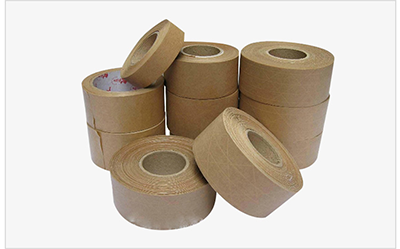 How To Use Water Activated Kraft Tape
 How to Use Water-Activated Kraft Paper Tape in Winter?